GEOTECHNICAL ENGINEERING1
BRIGHTON
HomeSeismicBase isolation seismic design

Base Isolation Seismic Design in Brighton

Practical geotechnics, field-tested.

LEARN MORE

Brighton sits on a geological transition that complicates seismic response. The Cretaceous Chalk of the South Downs meets the London Clay Formation along the coastal plain, with a water table often within 3 metres of ground level. This sharp stiffness contrast amplifies ground motion at the boundary, a pattern documented in the British Geological Survey's 1:50,000 sheet for the district. Structures founded across these two materials require isolation systems that decouple the superstructure from differential foundation movement. Seismic microzonation helps map these velocity contrasts before selecting isolator parameters, and when chalk dissolution features are suspected, resistivity profiling identifies voiding that would undermine isolator performance.

An isolation system tuned to chalk will resonate on London Clay unless the substructure is stiff enough to force the isolators into their non-linear range early.
Our service areas

Our approach and scope

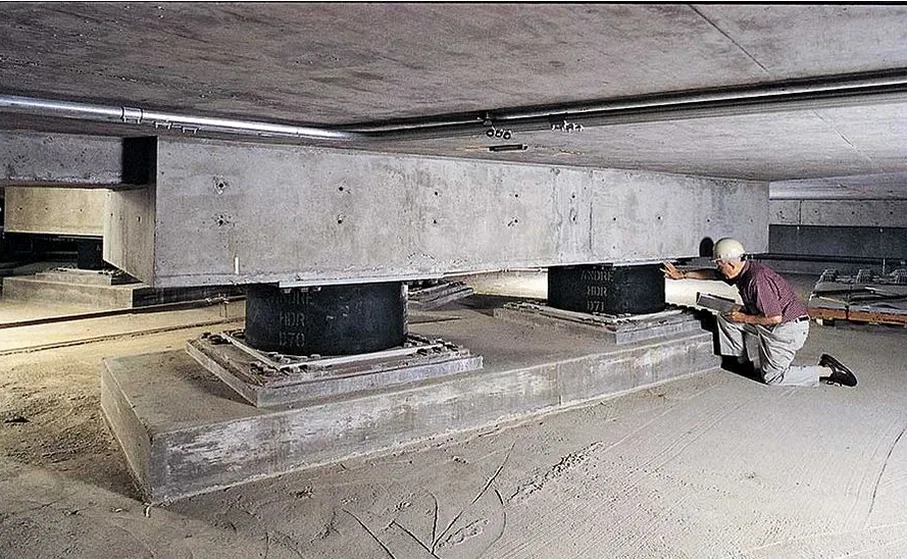
Brighton's population exceeds 290,000, with dense terraced housing on the coastal plain and heavier development on the chalk slopes. A base isolation design for this city must handle two distinct spectral demands within a single project footprint. The isolator period is typically pushed beyond 2.0 seconds to reduce acceleration into the superstructure, but the underlying soft clay pockets can generate site periods of 0.4 to 0.7 seconds, creating a tuning risk if the isolation gap is not adequately sized. We specify lead-rubber bearings or friction pendulum systems with displacement capacities matched to the 475-year return period hazard, and verify clearance against the 2,475-year event per Eurocode 8 Part 1. The isolation interface is detailed to permit inspection during the building's life, a requirement often overlooked in residential conversions along the seafront.
Base Isolation Seismic Design in Brighton
Technical reference — Brighton

Site-specific factors

Compare the Regency squares of Kemptown, founded on chalk at shallow depth, with the infill areas behind the marina where made ground exceeds 4 metres. A structure in Kemptown sees short-period, high-acceleration motion; one at the marina sees longer-period energy trapped in the softer deposits. Applying the same isolator properties to both sites is a design error we see in generic specifications. The isolator effective stiffness must be iterated with the substructure stiffness and the site-specific response spectrum, not copied from a manufacturer's catalogue. Ignoring this iteration leads to an under-damped system that drifts beyond the moat clearance during the design earthquake, locking the building against the retaining wall.

Need a geotechnical assessment?

Reply within 24h.

Email: contact@geotechnical-engineering1.com

Reference standards

BS EN 1998-1:2004 + UK National Annex (Eurocode 8 Part 1), BS EN 15129:2018 Anti-seismic devices, BS 5930:2015 + A1:2020 Code of practice for ground investigations, ISO 22762:2018 Elastomeric seismic-protection isolators, BRE Digest 477:2003 Seismic design of structures

Technical parameters

ParameterTypical value
Design life50 years (BS EN 1990)
Reference return period475 years (ULS) / 95 years (SLS)
Isolation plane locationAbove foundation, below ground floor slab
Lead core diameter (LRB)110–180 mm depending on axial load
Friction pendulum radius2.2–3.5 m for 2.5 s period
Gap / moat width≥ 1.2 × maximum displacement
Vertical stiffness ratio≥ 800 × horizontal stiffness

Quick answers

What does base isolation design cost for a Brighton project?

For a typical Brighton residential or low-rise commercial building, the design package including site-specific spectra, isolator selection, non-linear analysis, and detailing drawings falls between £2,990 and £7,260. The spread reflects building size, number of isolators, and whether peer review by an independent checker is required.

How does the chalk-clay boundary affect the isolation gap?

The boundary concentrates differential ground displacement. We run a minimum of seven ground-motion pairs scaled to the site-specific spectrum, checking the residual displacement in each direction. The moat gap is set to 1.2 times the 84th-percentile maximum from the suite, with an additional 15 mm allowance for thermal movement in Brighton's coastal climate.

Can existing buildings in Brighton be retrofitted with base isolation?

It is technically feasible but requires a temporary support system to cut the structure free at the isolation plane. For listed Regency buildings, we prefer a friction pendulum retrofit installed at basement level, keeping the intervention invisible from the street. The substructure must be stiffened with perimeter underpinning before the isolators are inserted.

Location and service area

We serve projects across Brighton and surrounding areas.

View larger map