GEOTECHNICAL ENGINEERING1
BRIGHTON
HomeSeismicSeismic microzonation

Seismic Microzonation Studies in Brighton: Ground Response & Site Classification

Practical geotechnics, field-tested.

LEARN MORE

Brighton sits on a complex geological boundary where the White Chalk Subgroup of the South Downs meets Quaternary Coombe deposits and raised beach terraces. The sudden change from stiff, fractured chalk to softer, saturated silty clays over distances of less than 200 metres creates abrupt variations in site response during seismic events. A generic seismic hazard map cannot capture this granularity. Our seismic microzonation work for Brighton projects maps VS30 and fundamental site period (T0) at the parcel scale, directly feeding into BS EN 1998-1 ground type determination and the selection of appropriate elastic response spectra for structural design. When working on the London Road viaduct redevelopments or coastal regeneration schemes east of the Palace Pier, we integrate MASW testing to resolve shear-wave velocity profiles through the variable cover, and seismic refraction to delineate the chalk bedrock surface where it dips beneath Holocene alluvium.

Two sites on the same Brighton postcode can fall into ground types B, C, or D depending on cover thickness over chalk, and that difference shifts the design spectrum by up to 40%.
Our service areas

Our approach and scope

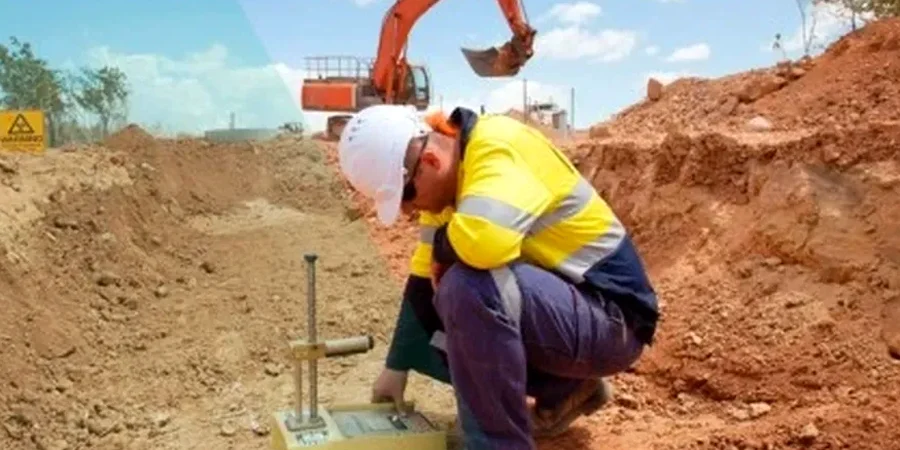
The field data for a Brighton microzonation study is acquired with a 24-channel seismograph connected to 4.5 Hz vertical geophones, laid out in arrays of 46 to 92 metres depending on target depth. On the Madeira Drive undercliff walk, where man-made ground overlies the chalk platform, we deploy shorter spreads with tighter geophone spacing to resolve the fill-bedrock interface. Ambient vibration recordings using triaxial broadband seismometers (30-second to 100 Hz flat response) run for a minimum of 30 minutes per station, capturing the microtremor spectrum needed for horizontal-to-vertical spectral ratio (HVSR) processing. The resulting Brighton-specific ground profiles serve as input for 1D equivalent-linear site response analysis using software such as DEEPSOIL or Strata, where we run suites of input motions matched to the UK seismic hazard spectrum. A critical complement in areas with soft cohesive soils is the CPT test, which provides continuous tip resistance and pore pressure data to constrain the undrained shear strength profile needed for liquefaction screening under BS EN 1998-5.
Seismic Microzonation Studies in Brighton: Ground Response & Site Classification
Technical reference — Brighton

Site-specific factors

Brighton and Hove's population exceeding 290,000 places the city firmly in importance class II and III structures under BS EN 1998-1, yet much of the Victorian-era terraced housing and seafront infrastructure pre-dates any modern seismic consideration. The Chalk itself, while strong in compression, is prone to solution features and dissolution pipes filled with soft clay; these buried hollows act as seismic wave traps, amplifying ground motion locally by factors of 1.5 to 2.0 according to 2D site response models. The Coombe deposits, a periglacial head of chalk rubble in a silty clay matrix, exhibit stiffness degradation under cyclic loading that 1D analyses alone may underestimate. Our Brighton microzonation reports flag these geomorphological hazards explicitly, providing contour maps of aggravation factor and recommending where 2D basin-edge effect analyses should supplement the standard 1D approach.

Need a geotechnical assessment?

Reply within 24h.

Email: contact@geotechnical-engineering1.com

Reference standards

BS EN 1998-1:2004 (Eurocode 8 Part 1) – Seismic design of structures, ground types and elastic response spectra, BS EN 1998-5:2004 (Eurocode 8 Part 5) – Foundations, retaining structures and geotechnical aspects, BS 5930:2015+A1:2020 – Code of practice for ground investigations, BS 1377/D4428M-14 – Standard Test Methods for Crosshole Seismic Testing (adapted for downhole MASW), FEMA P-1050-1 NEHRP Provisions – Site classification and ground motion amplification

Technical parameters

ParameterTypical value
Measured parameterVS30 (m/s), T0 (s), HVSR peak frequency (Hz)
Seismograph channels24-channel, 24-bit A/D conversion
Geophone natural frequency4.5 Hz vertical component (MASW/refraction)
Broadband sensor bandwidth30 s to 100 Hz flat response (HVSR)
Ground type classification standardBS EN 1998-1:2004, Table 3.1
Site response softwareDEEPSOIL v7 / Strata / SHAKE2000
Input motion selectionSpectrum-matched to UK seismic hazard (SHARE/BGS)
Reporting outputGround type map, VS30 contour map, design spectra per zone

Quick answers

What is a seismic microzonation study and why does my Brighton project need one?

A seismic microzonation study maps how the ground at a specific site amplifies earthquake shaking, rather than relying on a regional hazard map. In Brighton the transition from chalk to Coombe deposits creates sharp changes in ground stiffness over short distances. The study provides your structural engineer with the correct ground type (A through E) per BS EN 1998-1 and the site-specific elastic response spectrum, avoiding both over-design and unsafe under-design. Planning authorities in Brighton and Hove increasingly request this level of detail for developments over 2,000 square metres or on sites with known variable ground conditions.

How much does a seismic microzonation study cost in Brighton?

The cost ranges from £3,130 for a basic VS30 determination on a single-building plot using one MASW line and one HVSR station, up to £15,220 for a full microzonation of a multi-hectare development site including multiple geophysical lines, HVSR grid, 1D site response analysis, and contour mapping. Factors affecting the price include site access constraints on the Brighton seafront, the required depth of investigation, and whether 2D basin modelling is needed for buried chalk valleys.

What geophysical methods are used for seismic microzonation in Brighton's chalk geology?

The primary methods are Multichannel Analysis of Surface Waves (MASW) for VS30 profiling, seismic refraction to map the top-of-chalk surface, and Horizontal-to-Vertical Spectral Ratio (HVSR) from ambient noise recordings to determine fundamental site period. On Brighton sites with thick Coombe deposits or made ground, we may supplement with downhole seismic in boreholes where surface-wave methods cannot resolve deep velocity contrasts. For liquefaction-susceptible silts near the coast, CPT data are correlated with shear-wave velocity for a combined assessment.

How long does a seismic microzonation study take from field work to final report?

Field data acquisition typically requires 2 to 4 days on site, depending on the number of geophysical lines and HVSR stations. The processing, inversion, and numerical site response analysis phase takes 3 to 4 weeks. The final report including ground type maps, VS30 contour plans, and design response spectra is delivered within 5 to 6 weeks of completing field work. We coordinate with your project programme and can provide preliminary ground type recommendations within 5 working days of field data collection.

Location and service area

We serve projects across Brighton and surrounding areas.

View larger map