GEOTECHNICAL ENGINEERING1
BRIGHTON
HomeLaboratoryTriaxial test

Triaxial Testing Brighton | Advanced Shear Strength Analysis for Coastal Soils

Practical geotechnics, field-tested.

LEARN MORE

Brighton sits on a complex geological boundary where the South Downs chalk meets Quaternary coastal deposits and London Clay Formation outcrops. This transition creates highly variable ground conditions: stiff fissured clay one borehole, structureless chalk putty the next. For any project involving deep foundations, retaining structures, or cut slopes along the A27 corridor, accurate shear strength parameters are non-negotiable. A consolidated-undrained triaxial test extracts the effective stress envelope—c' and φ'—that governs long-term stability in these materials. Without it, you are designing blind, especially where groundwater perched within the chalk or within sand lenses in the clay can halve the factor of safety between neighbours just 50 metres apart. Our Brighton-based technical team runs multistage triaxial programs in an ISO 17025-accredited facility, delivering data that directly feeds into Eurocode 7 design approaches. For projects on the coastal plain where soft alluvium is present, we often pair triaxial testing with in-situ permeability measurements to capture the coupled hydromechanical behaviour that controls consolidation settlement.

Triaxial testing on Brighton chalk reveals that peak friction angle can exceed 38 degrees, but post-peak softening reduces it to below 30—a margin that decides whether a retaining wall stands or fails.
Our service areas

Our approach and scope

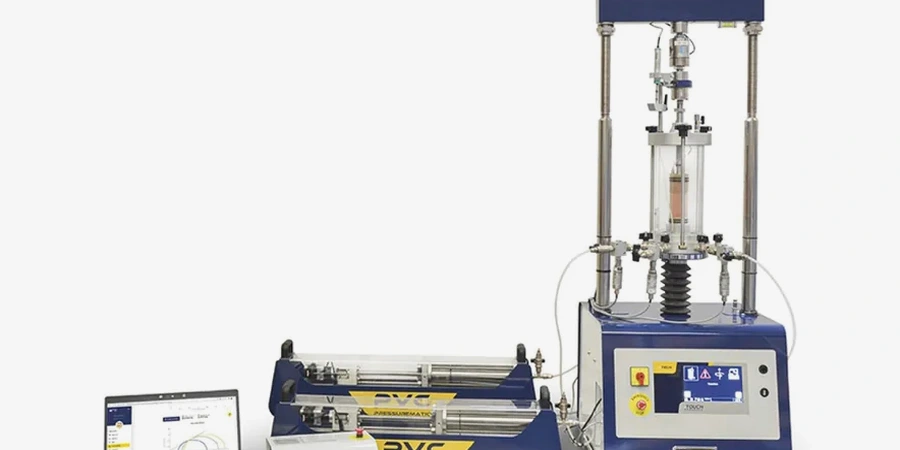
BS EN 1997-2:2007 and BS 1377-8:1990 govern triaxial test procedures in the UK, but Brighton's geology demands interpretation beyond the standards. Chalk, for instance, exhibits a yielding behaviour that conventional Mohr-Coulomb envelopes miss: peak strength is mobilised at very small strains, after which rapid softening occurs. Our laboratory runs both single-stage and multi-stage CIU and CID tests on 100 mm specimens, applying back-pressure saturation until Skempton's B parameter exceeds 0.95—essential for the low-permeability Gault Clay found beneath parts of the city. We measure pore pressure response throughout shearing, because the dilative or contractive tendency of the soil tells you more about serviceability than the peak strength alone. The report includes stress-strain curves, p'-q plots, and interpreted parameters for drained and undrained conditions: effective cohesion intercept, effective friction angle, and undrained shear strength ratio. These numbers feed directly into the bearing capacity calculations for footings on the chalk, where the design must account for dissolution features and potential void migration. For the London Clay, we also determine the overconsolidation ratio influence on the undrained strength profile.
Triaxial Testing Brighton | Advanced Shear Strength Analysis for Coastal Soils
Technical reference — Brighton

Site-specific factors

Brighton's seafront postcode and the chalk aquifer beneath the South Downs create a risk profile that standard desk studies underestimate. The city sits at elevations ranging from sea level to over 100 metres within a few kilometres inland, generating steep hydraulic gradients. In the chalk, dissolution pipes and infilled sinkholes are documented along the coastal strip—features that produce highly compressible zones with shear strengths far below the intact rock. Relying on SPT N-values or index tests alone to characterise these materials misses the strain-softening behaviour that triggers progressive failure. A 2016 slope instability event near Roedean, where a section of undercliff walk was closed for six months, was traced back to a thin clay seam within the chalk that had been overlooked during ground investigation. Triaxial testing on undisturbed samples from that horizon would have revealed the low effective friction angle and high pore pressure response. We also test the Lambeth Group sands where they outcrop near the marina: loose, contractive sands that can liquefy under cyclic loading if not identified and treated.

Need a geotechnical assessment?

Reply within 24h.

Email: contact@geotechnical-engineering1.com

Reference standards

BS 1377-8:1990 Soils for civil engineering purposes — Shear strength tests (effective stress), BS EN 1997-2:2007 Eurocode 7 — Geotechnical design — Ground investigation and testing, ISO/TS 17892-9:2004 Geotechnical investigation — Laboratory testing — Consolidated triaxial tests

Technical parameters

ParameterTypical value
Specimen diameter100 mm (chalk/clay), 70 mm (sands)
Test typesCIU, CID, UU, multi-stage
Saturation criterionSkempton B > 0.95
Shearing rate (CIU)0.05 to 0.5 mm/min per BS 1377
Consolidation stages3 effective stress levels per specimen
Pore pressure measurementMid-plane probe, electronic transducer
ReportingMohr-Coulomb envelope, p'-q, stress path

Quick answers

Why can't I just use SPT blow counts to estimate shear strength in Brighton chalk?

SPT N-values provide an empirical correlation for granular soils but are unreliable in structured chalk, where the degree of fracturing, saturation, and the presence of putty chalk zones control strength. Triaxial testing measures the effective stress parameters directly and captures the strain-softening behaviour that SPT cannot detect. BS EN 1997-2 specifically recommends triaxial testing for structured soils where the failure mechanism involves cementation breakdown.

How long does a multistage CIU triaxial test take from sample delivery to report?

A standard three-stage CIU program on a 100 mm specimen typically requires 10 to 14 working days. This includes specimen preparation, saturation until B>0.95, consolidation at three effective stress levels, undrained shearing at controlled rate, and interpretation. If the chalk or clay sample requires extended saturation due to low permeability, we will inform you of the adjusted timeline. Express turnaround is available for urgent design deadlines.

What does triaxial testing cost for a project in Brighton?

For a multistage CIU test program, pricing ranges from £1,630 to £1,940 depending on the number of specimens, the test type (CIU, CID, or UU), and whether local strain instrumentation is required. This includes saturation, consolidation, shearing, and a full interpretive report with Mohr-Coulomb parameters and stress path plots. We provide a fixed-price quotation after reviewing the borehole logs and project requirements.

Can you test the Lambeth Group sands from the Brighton Marina area for liquefaction assessment?

Yes. We run cyclic triaxial tests on undisturbed or reconstituted specimens of Lambeth Group sands to determine the cyclic resistance ratio (CRR) as a function of number of cycles. The test follows the procedure outlined in BS EN ISO 17892-9 and is interpreted alongside the site-specific seismic hazard. For the Brighton coastal zone, where the water table is high and the sands are loose, this is a critical input to any foundation design under seismic loading.

Location and service area

We serve projects across Brighton and surrounding areas.

View larger map