GEOTECHNICAL ENGINEERING1
BRIGHTON
HomeInvestigationCPT (Cone Penetration Test)

CPT Testing Brighton | Cone Penetration Tests BS EN 1997

Practical geotechnics, field-tested.

LEARN MORE

A developer broke ground on a seafront apartment block off Marine Parade last year. The boreholes said competent chalk at 4 metres. The piling rig hit a soft, putty-like layer at 5.5 metres and the casing nearly collapsed. Three days of delays and a revised foundation scheme later, the contractor brought us in to run a CPT profile across the site. Brighton’s geology is deceptive. The White Chalk Subgroup dips beneath variable Head deposits, Coombe Rock and raised beach shingle, and the transition zones are rarely uniform. We run the cone penetration test to map those transitions precisely, giving engineers continuous resistance data that borehole logs cannot capture on their own. For deep foundations near the seafront or basement excavations in the North Laine area, CPT results clarify the real stratigraphy before steel goes in the ground.

Continuous cone resistance data catches the soft seams that boreholes miss, and on Brighton's chalk those seams change the foundation design completely.
Our service areas

Methodology and scope

The difference between a site in Hove and one up in Hollingbury is stark. Along the coastal plain we often encounter soft alluvium and saturated shingle over chalk, where pore pressure dissipation tests during CPT runs tell us more about drainage behaviour than any lab sample. Move inland to the South Downs dip slope and the chalk is often weathered to structureless grade Dc/Dm material, with cone resistance values that can halve over less than 300 metres laterally. We see this on almost every Brighton job. That is why we run the cone at 2 cm/s with a 15 cm² tip, logging qc, fs and u2 simultaneously. For contaminated land assessments on former gasworks or industrial plots, the CPT also provides rapid screening without cuttings, which matters when you are working next to occupied buildings in Kemptown or Hanover.
CPT Testing Brighton | Cone Penetration Tests BS EN 1997
Technical reference — Brighton

Local considerations

Brighton’s coastal humidity and winter groundwater recharge create conditions where CPT interpretation without local calibration can mislead. The chalk aquifer rises after prolonged rain, increasing pore pressure and reducing effective cone resistance. An engineer reading a dry-summer CPT trace might overestimate end-bearing capacity by 15–20% if the water table shift is not factored in. We cross-reference pore pressure dissipation tests against Environment Agency groundwater level data for the Brighton Chalk block before finalising any soil behaviour type classification. On sites within 200 metres of the seafront, saline intrusion adds a further variable: elevated electrical conductivity alters the CPTu response and requires correction to avoid misclassifying chalk as clay. These are not theoretical risks. They show up in pile load test failures when the ground model relies on sparse borehole data alone.

Need a geotechnical assessment?

Reply within 24h.

Email: contact@geotechnical-engineering1.com

Applicable standards

BS EN ISO 22476-1:2012 (Geotechnical investigation – CPT), BS 5930:2015 + A1:2020 (Code of practice for ground investigations), Eurocode 7 – BS EN 1997-2:2007 (Ground investigation and testing), ICE Specification for Ground Investigation, Second Edition

Technical parameters

ParameterTypical value
Cone tip area15 cm² (standard)
Penetration rate20 mm/s ± 5 mm/s
Measured parametersqc, fs, u2 (pore pressure)
Friction ratioRf = fs/qc × 100 (%)
Maximum thrust (track rig)200 kN
Sleeve friction range0–1.0 MPa typical
Data recording interval10 mm (Class 2 to BS EN ISO 22476-1)
Pore pressure sensorSaturated filter, de-aired glycerin

Frequently asked questions

What depth can a CPT rig reach in Brighton’s chalk?

Depends entirely on the chalk grade and flint content. In weathered Grade Dc chalk around Patcham or Hollingbury, we typically achieve 12–15 metres before refusal on flint bands. In massive Grade B chalk further north, refusal can occur at 6–8 metres. We specify thrust capacity per site after reviewing nearby GI records.

How much does a CPT test cost in Brighton?

A single CPT probe with full piezocone logging generally falls in the range of £120 to £220 per probe, depending on depth, access constraints and whether pore pressure dissipation tests are required. Mobilisation and reporting are quoted separately based on the number of probes and site location within the city.

Can CPT testing be done on small residential sites in Brighton?

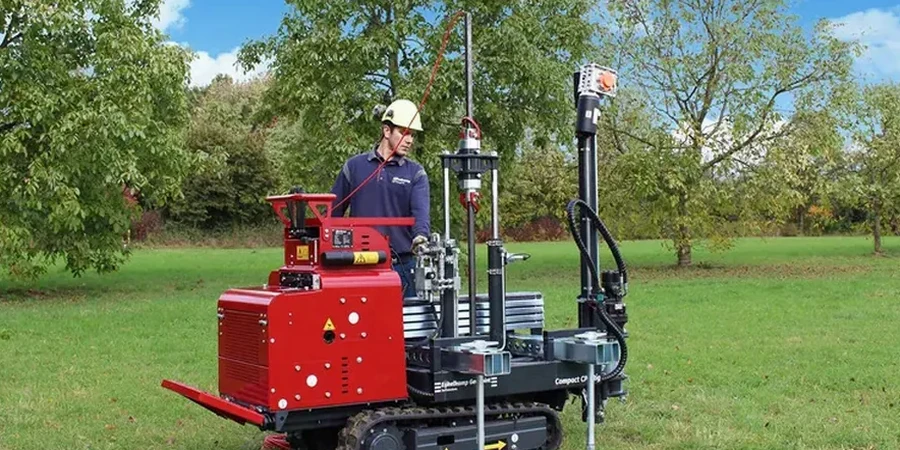
Yes. We use a compact tracked rig that fits through standard garden gates and works on slopes up to 25 degrees. For terraced properties in areas like Seven Dials or Hanover where access is tight, CPT often replaces trial pits and minimises disturbance to neighbouring foundations.

How long does a CPT investigation take on site?

A single probe to 10 metres takes about 30–45 minutes of penetration time. With setup, calibration checks and any dissipation tests, plan for roughly one hour per probe location. A typical three-probe residential investigation is usually completed within a morning.

Do you provide interpreted soil parameters from the CPT data?

Absolutely. Every report includes interpreted geotechnical parameters: undrained shear strength (su), friction angle estimates, constrained modulus and soil behaviour type classification. We use the Robertson (1990) charts and cross-check against any available laboratory data from the Brighton area.

Location and service area

We serve projects across Brighton and surrounding areas. More info.

View larger map