GEOTECHNICAL ENGINEERING1
BRIGHTON
HomeIn-Situ TestingField density test (sand cone method)

Field Density Testing Brighton: Sand Cone Method for Reliable Compaction Control

Practical geotechnics, field-tested.

LEARN MORE

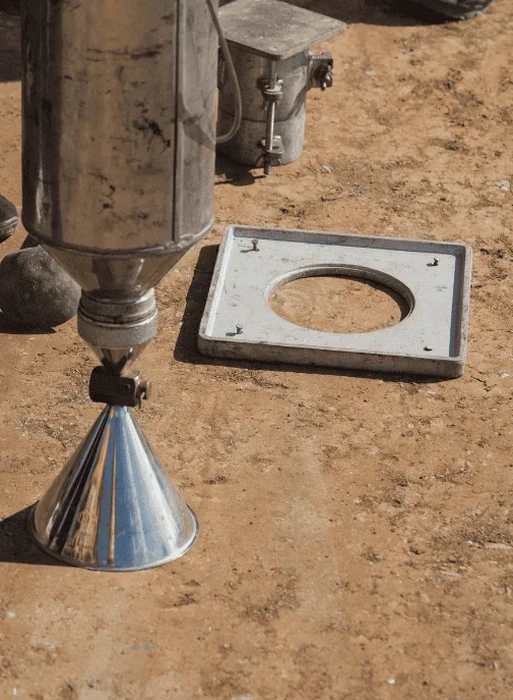
The ground beneath Brighton tells two very different stories depending on where you stand. Up toward the Race Hill area and around Hollingbury, you encounter the firm chalk of the South Downs—weathered at the surface but competent at depth. Down by the seafront and the Lanes, however, the geology shifts to raised beach deposits, shingle, and pockets of made ground from centuries of coastal settlement. These contrasts matter enormously when verifying earthwork compliance. A sand cone density test performed on a chalk fill behind the marina will yield a different baseline than the same procedure applied to compacted gravel at a Preston Park development. Our laboratory, accredited to ISO 17025, runs these field density checks under BS 5930 and BS 1377 protocols, adapting the reference density to Brighton's local materials—something a generic lab unfamiliar with the South Coast won't account for. The sand cone method remains the most practical direct-measurement technique for layer-by-layer compaction verification on sites where nuclear gauges face regulatory hurdles.

A sand cone test on Brighton chalk fill is only as good as the Proctor curve behind it—calibrate both to the local geology, not a generic database.
Our service areas

Methodology and scope

A common mistake we see with Brighton contractors is assuming the maximum dry density from a standard Proctor curve will match the field condition of a chalk fill placed at 15% moisture in February. It rarely does. Brighton's chalk crushes during compaction, altering its particle-size distribution and shifting the reference density. You cannot verify that shift with a nuclear gauge alone. The sand cone method gives you a direct volume measurement, independent of material chemistry. To get it right, we calibrate the cone sand's bulk density daily against the site's temperature and humidity—Brighton's sea air carries enough moisture to skew poorly stored calibration sand by 2-3%. This is where the Proctor tests link becomes critical: without a site-specific compaction curve run on the actual fill material, your field density percentage means nothing. Our technicians sieve the excavation spoils on site, check for oversized particles, and adjust the reference accordingly. For projects transitioning from the chalk spine of the city down toward the Holocene alluvium near the River Adur, we often recommend pairing the sand cone with a test pit investigation to visually confirm the fill stratigraphy before interpreting density numbers.
Field Density Testing Brighton: Sand Cone Method for Reliable Compaction Control
Technical reference — Brighton

Local considerations

Brighton's coastal exposure creates a compaction risk that inland sites rarely face: salt-laden wind drying out the upper 50 mm of a lift before the next layer is placed. That crust then traps moisture beneath, creating a shear plane exactly where you don't want one. We have measured relative compaction dropping from 97% to 88% across a single 200 mm lift on a windy March afternoon near the Palace Pier. The sand cone method catches this because it samples the full lift thickness—not just the surface. On the other side of the city, the clay-with-flints that drapes the chalk in patches around Patcham and Coldean presents a different challenge: it's highly moisture-sensitive, and a density test run the day after rain will read deceptively low, not because compaction was poor, but because the material swelled overnight. Our field reports flag these ambient conditions explicitly—air temperature, wind, recent rainfall, and time since placement—so the engineer interpreting the 92% result knows whether the number reflects compaction effort or environmental exposure.

Need a geotechnical assessment?

Reply within 24h.

Email: contact@geotechnical-engineering1.com

Explanatory video

Applicable standards

BS 1377-9:1990, BS 5930:2015+A1:2020, Manual of Contract Documents for Highway Works (MCHW), Series 600, Eurocode 7 (BS EN 1997-2:2007)

Technical parameters

ParameterTypical value
Test standardBS 1377-9:1990 (sand replacement method)
Reference specificationSeries 600 Earthworks (SHW)
Sand typeGraded silica sand, single-sized (typically 600-300 µm)
Cone calibration frequencyDaily, plus after each sand batch change
Minimum test depth1.5x maximum particle size of fill material
Typical test hole diameter100-150 mm in fine soils, up to 200 mm in coarse gravel
Reporting parameterRelative compaction (%) vs. laboratory Proctor

Frequently asked questions

How much does a field density test using the sand cone method cost in Brighton?

For sites in Brighton and the wider East Sussex area, a single sand cone density test typically runs between £80 and £110 per point, depending on the number of tests booked on the same visit and the travel distance from our laboratory. Most earthworks QA programmes require a minimum of one test per 500 m² per lift, so a small commercial plot might need four to six points per day. We quote per project rather than per point when testing volumes justify it—call with your specification and we will provide a fixed price.

Does the sand cone method work in Brighton's chalk fill or does it give unreliable results?

It works well, but it demands careful technique. The main risk with chalk fill is particle crushing during excavation of the test hole—if the sides collapse, the volume measurement is wrong. Our technicians use a smaller excavation diameter in chalk than in gravel, and we validate the hole volume with a second sand pour if the material is friable. The method is fully compliant with BS 1377-9 and remains the most direct way to measure in-place density without radiation licensing issues.

What is the difference between a sand cone test and a nuclear density gauge test for Brighton earthworks?

The sand cone method measures density directly by excavating a known volume of soil, weighing it, and calculating the wet and dry density from the moisture content. It is a destructive, point-in-time test that samples the full lift depth. A nuclear gauge measures density indirectly via gamma radiation backscatter or transmission, giving an instantaneous result without excavation. In Brighton, nuclear gauges face strict transport and on-site security requirements, and the readings can be thrown off by the variable mineralogy of chalk and flint-rich fills. The sand cone avoids those issues entirely, which is why many local authorities and consulting engineers still specify it for final acceptance testing on highway and drainage trench reinstatements.

Location and service area

We serve projects across Brighton and surrounding areas.

View larger map