GEOTECHNICAL ENGINEERING1
BRIGHTON
HomeUnderground ExcavationsGeotechnical analysis for soft soil tunnels

Soft Ground Tunnel Geotechnics in Brighton: Site Characterisation and Design Parameters

Practical geotechnics, field-tested.

LEARN MORE

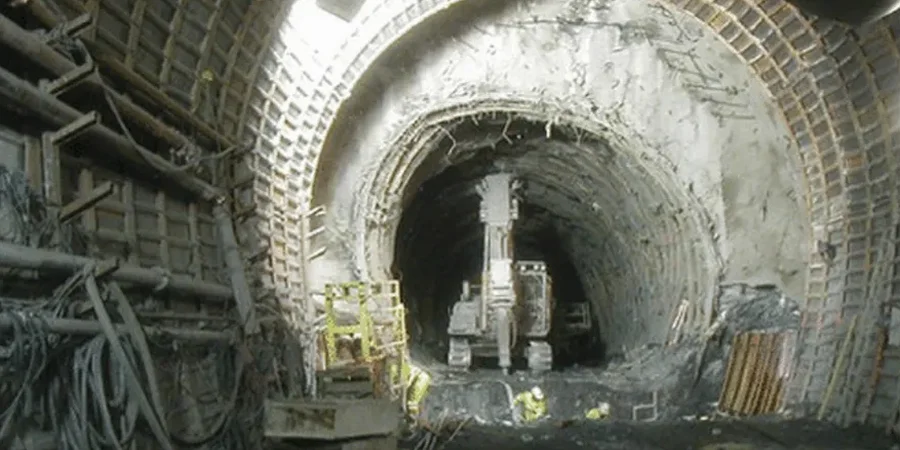
Brighton sits at the foot of the South Downs on a sequence of Upper Chalk, Coombe Deposits, and raised beach terraces, with groundwater perched at multiple levels across the city. The 4.5 km Brighton Main Line tunnel, opened in 1841, cuts through Lewes Nodular Chalk and is a permanent reminder that tunnel behaviour in this city is governed by fracture spacing, matrix porosity, and the flint bands that deflect TBMs. When a new scheme is planned—whether a utility adit near Preston Park or a sewer connection under the A23—the ground model must resolve the transition between stiff chalk and the overlying soft drift because stand-up time can drop from days to hours across a few metres of face advance. Our laboratory is UKAS-accredited for triaxial and index testing to BS 5930:2015, and we run the full cycle from test pits for disturbed sampling to advanced triaxial multi-stage tests that capture the yield envelope of remoulded Coombe Deposits. That data feeds directly into the Hoek-Brown and SHANSEP parameters the design team needs.

Stand-up time in Brighton\'s Coombe Deposits can fall below 6 hours in a 3 m heading, making continuous face support and staged excavation sequencing non-negotiable.
Our service areas

Methodology and scope

The contrast between a site near Brighton Marina and one upslope in Hollingbury illustrates why a single set of parameters never works here. At the marina, the tunnel crown often lies in the Storm Beach Deposits—loose, water-bearing shingle over chalk—requiring pre-support with canopy tubes and a face pressure that balances the tidal head. In Hollingbury, the tunnel is deeper into the Lewes Nodular Chalk, where the risk shifts to block fallout along persistent joint sets striking 110°–130°. We characterise these differences with a combination of rotary cored boreholes logged to BS EN ISO 14688-2:2018, downhole geophysics, and in-situ permeability tests using Lugeon and falling-head methods. The lab programme follows with point load tests on intact cores, slake durability for the marl seams, and consolidated-undrained triaxials with pore pressure measurement to define the undrained shear strength ratio of the drift. The output is a layered ground model with stiffness degradation curves for each unit, calibrated against the GSI observations from the core run, so that the PLAXIS 2D/3D analysis captures the correct convergence profile.
Soft Ground Tunnel Geotechnics in Brighton: Site Characterisation and Design Parameters
Technical reference — Brighton

Local considerations

BS EN 1997-1:2004 requires a Ground Investigation Report that explicitly addresses the hazards of tunnelling in variable drift-over-chalk sequences, and in Brighton this means confronting three interrelated risks. First, the Coombe Deposits are matrix-dominated solifluction material with occasional chalk rafts up to 2 m across; a TBM or roadheader that hits a raft can experience uncontrolled torque spikes and face instability. Second, the chalk aquifer is unconfined along the coastal strip and tidally influenced, so a sudden drop in face pressure can induce inflow rates exceeding 15 L/s in open discontinuities. Third, the flint bands in the Seaford and Lewes Chalk formations act as hard, abrasive layers that accelerate tool wear—cutter consumption can double relative to a homogeneous chalk drive. Our risk report quantifies these hazards using the GIM (Geotechnical Baseline Report) methodology, provides face pressure envelopes for EPB operation, and sets trigger levels for settlement at sensitive structures like the Royal Pavilion and the Victorian sewers beneath the Old Steine.

Need a geotechnical assessment?

Reply within 24h.

Email: contact@geotechnical-engineering1.com

Applicable standards

BS 5930:2015, BS EN 1997-1:2004 (Eurocode 7), BS EN ISO 14688-2:2018, BS EN ISO 17892-9:2018 (Triaxial), CIRIA C760 – Guidance on embedded retaining wall design

Technical parameters

ParameterTypical value
Intact UCS (Lewes Nodular Chalk)18 – 45 MPa
Undrained shear strength, Coombe Deposit40 – 90 kPa
Permeability, Storm Beach Gravel5 × 10⁻³ – 1 × 10⁻² m/s
GSI range, structured chalk50 – 65
Slake durability index (Id2), marl seams60 – 85 %
K₀ (overconsolidated chalk)0.8 – 1.2 (depth-dependent)
Young’s modulus (E₅₀ ref), Coombe Deposit8 – 22 MPa

Frequently asked questions

What is the typical cost of a geotechnical investigation for a soft-ground tunnel in Brighton?

A ground investigation for a tunnel feasibility or detailed design stage in Brighton typically ranges from £3,560 for a single borehole with basic lab testing to £14,710 for a multi-hole campaign with in-situ permeability, advanced triaxials, and a Geotechnical Baseline Report. The spread depends on the number of boreholes, the depth to tunnel axis, and whether downhole geophysics is included.

How do you model the Coombe Deposits for a tunnel face stability analysis?

We treat the Coombe Deposits as a heavily overconsolidated, low-plasticity silty clay with chalk clasts. Undrained shear strength is derived from CIU triaxial tests and normalised against the SHANSEP framework, while the stiffness degradation curve uses the small-strain shear modulus from bender-element tests. In PLAXIS, we apply the Hardening Soil model with small-strain overlay to capture the non-linear response around the face.

What are the key differences between tunnelling in chalk and in the overlying drift in Brighton?

The Lewes and Seaford Chalk formations are blocky, medium-strength rocks where instability is structurally controlled by joint persistence and orientation. The drift—Coombe Deposits and Storm Beach Gravel—behaves as a soil, with stand-up time measured in hours and face stability governed by undrained shear strength and groundwater. The transition zone between the two is the most critical section of any Brighton tunnel and requires a carefully staged excavation sequence with spiling or canopy tubes.

Which Brighton structures require the most conservative settlement assessment during tunnelling?

The Royal Pavilion, the Brighton Dome, and the Victorian brick sewers beneath the Old Steine are all highly sensitive to ground movement. We set settlement trigger values at 5 mm for the Pavilion and 10 mm for the main sewer, with real-time monitoring via automated total stations and in-tunnel levelling. The building damage assessment follows the CIRIA C760 methodology, using the tensile strain limit of 0.05% for the Pavilion\'s historic masonry.

Location and service area

We serve projects across Brighton and surrounding areas.

View larger map