GEOTECHNICAL ENGINEERING1
BRIGHTON
HomeLaboratoryGrain size analysis (sieve + hydrometer)

Grain size analysis Brighton: sieve and hydrometer testing to BS 5930

Practical geotechnics, field-tested.

LEARN MORE

Brighton sits on a complex chalk escarpment that plunges beneath Quaternary deposits along the coastal plain, with ground elevations ranging from sea level to over 100 metres within the city limits. This geological transition creates highly variable particle size distributions across relatively short distances: coarse chalk gravels in the north, silty sands through the city centre, and marine clays near the marina. A grain size analysis combining sieve and hydrometer methods provides the full grading curve needed for classification under BS 5930:2015+A1:2020. The chalk geology that defines the South Downs means even small variations in fines content can shift a material from free-draining to frost-susceptible, which matters enormously for pavement design and foundation drainage. When site investigation boreholes encounter mixed strata, we often pair the particle size distribution with Atterberg limits to confirm plasticity characteristics, and run CPT testing where continuous profiling through the chalk-sand interface is required.

Putty chalk fines in Brighton can shift a soil from granular to cohesive classification with just a 5% increase in silt content — the hydrometer curve catches what sieves miss.
Our service areas

Methodology and scope

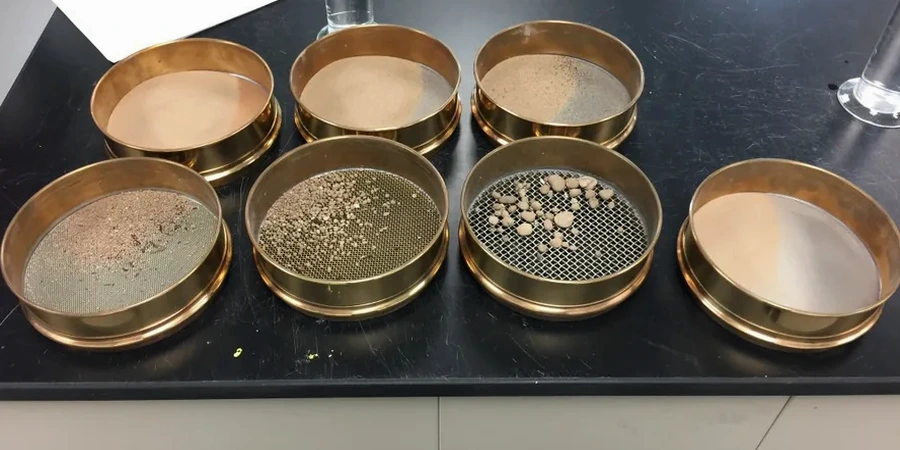
In Brighton, the local weathered chalk known as putty chalk routinely produces fines contents between 15 and 55 percent, which sits right on the boundary between coarse and fine-grained behaviour under the BS 5930 classification system. A combined sieve and hydrometer analysis resolves this ambiguity definitively. The sieve stack covers the range from 75 mm down to 63 microns using BS standard mesh sizes, while the hydrometer extends the curve down to 2 microns using Stokes' law sedimentation calibrated at 20°C laboratory temperature. The full procedure follows BS 1377-2:1990 Section 9 for soils and draws on BS 1377 for the hydrometer component when international reporting is specified. For projects requiring compaction control of the coarse fraction, we recommend complementing the grain size distribution with Proctor compaction tests to establish the moisture-density relationship. The transition zone between the coarse and fine fractions, typically around the 63-micron sieve, demands particular care because this is where Brighton's chalk-derived silts concentrate and where many classification errors originate.
Grain size analysis Brighton: sieve and hydrometer testing to BS 5930
Technical reference — Brighton

Local considerations

A residential development on a sloping site near Hollingbury encountered serious drainage failure two years after completion. The original ground investigation relied solely on sieve analysis and classified the weathered chalk material as well-graded sand with gravel. No hydrometer was specified. When the retaining wall drainage clogged and groundwater backed up behind the structure, subsequent testing revealed 28% silt and clay content that the sieves had simply washed through unmeasured. The material was actually a silty sand, borderline frost-susceptible, and entirely unsuitable for the free-draining backfill the design assumed. Remediation required installing new drainage at depth and replacing 40 cubic metres of backfill. A combined sieve and hydrometer analysis, costing under two hundred pounds at the time, would have flagged the fines content immediately. Brighton's putty chalk and Head deposits demand the full grading curve — skipping the sedimentation phase on chalk-derived soils is a risk that compounds with every metre of fill placed.

Need a geotechnical assessment?

Reply within 24h.

Email: contact@geotechnical-engineering1.com

Applicable standards

BS 5930:2015+A1:2020 — Code of practice for ground investigations, BS 1377-2:1990 Section 9 — Methods of test for soils: classification tests (wet sieving and hydrometer), Eurocode 7 (BS EN 1997-2:2007) — Ground investigation and testing, BS 1377 — Standard test method for particle-size distribution of fine-grained soils using hydrometer analysis

Technical parameters

ParameterTypical value
Sieve range (dry/wet)75 mm to 63 µm (BS mesh series)
Hydrometer range63 µm to 2 µm (ASTM 152H hydrometer)
Minimum test mass0.2 kg (fine) to 50 kg (coarse) per BS 1377-2
Dispersing agentSodium hexametaphosphate (40 g/L solution)
Sedimentation temperature20 °C ± 0.5 °C controlled water bath
Reporting parametersD10, D30, D60, Cu, Cc, % gravel/sand/silt/clay
AccreditationUKAS ISO/IEC 17025 for geotechnical testing

Frequently asked questions

What is the difference between sieve and hydrometer analysis?

Sieve analysis separates particles by physical shaking through a stack of mesh sieves, covering the range from 75 mm down to 63 microns. Hydrometer analysis measures the sedimentation rate of particles smaller than 63 microns suspended in water, using Stokes' law to calculate particle diameters down to 2 microns. The two methods together produce a complete grading curve. Sieves work well for sands and gravels; the hydrometer is essential for silts and clays where particle size controls drainage, frost behaviour, and classification under BS 5930.

How much does grain size analysis cost in Brighton?

A combined sieve and hydrometer analysis typically costs between £80 and £170 per sample, depending on whether the full sedimentation phase is required and the number of sieve fractions reported. Wet sieve analysis alone starts at the lower end of this range. Turnaround is usually three to five working days from sample receipt.

Why does Brighton's chalk geology require hydrometer testing?

Brighton's weathered chalk, particularly the putty chalk and Head deposits found across the city, produces significant quantities of silt-sized particles during weathering. These fines are too small to be captured by sieves alone but large enough to fundamentally alter the soil's engineering behaviour. A material that appears granular by eye may contain 20 to 40 percent silt, making it frost-susceptible and poorly draining. The hydrometer quantifies this fraction precisely.

What sample mass is required for a full grain size analysis?

Sample mass depends on the maximum particle size present. For fine soils passing the 2 mm sieve, a minimum of 200 grams is required. For soils containing gravel up to 20 mm, around 2 kg is needed. Coarse materials with particles up to 75 mm require up to 50 kg. We advise clients to submit at least 1 kg of material from each stratum to allow for repeat testing if required, particularly when working with Brighton's variable chalk-derived soils.

Location and service area

We serve projects across Brighton and surrounding areas.

View larger map